
Keya Paha Court Records After Arrest
A Keya Paha County arrest can create two related but separate record trails. The sheriff's trail covers custody, booking, release, transfer, and local jail status. The court trail begins when formal charges are filed and a Nebraska trial court case is opened. The local prosecutor is the Keya Paha County Attorney, Eric Scott, whose official county page lists the county attorney contact point for criminal case work after an arrest.
For custody and booking status, use Keya Paha County jail inmate records. For booking photos, use the Keya Paha County jail mugshots topic. Court records after a jail arrest answer a different question: what charge did the prosecutor file, what court is handling the case, what bond order exists, what hearings are set, and how the case ended.
Search Court Records After Arrest
Nebraska trial court records are searched through JUSTICE for county and district court cases. The Nebraska Judicial Branch states that case information may include a case summary, parties, offense information in criminal cases, financial information, the register of actions, judge notes when applicable, and many filed document images. New case entries may lag before they appear online, so a very recent Keya Paha County arrest may require a phone call to the clerk or sheriff before the court record appears.
The Nebraska Judicial Branch case information page explains how court case searches work and how public access is split between courthouse terminals, online one-time searches, and subscriber services.
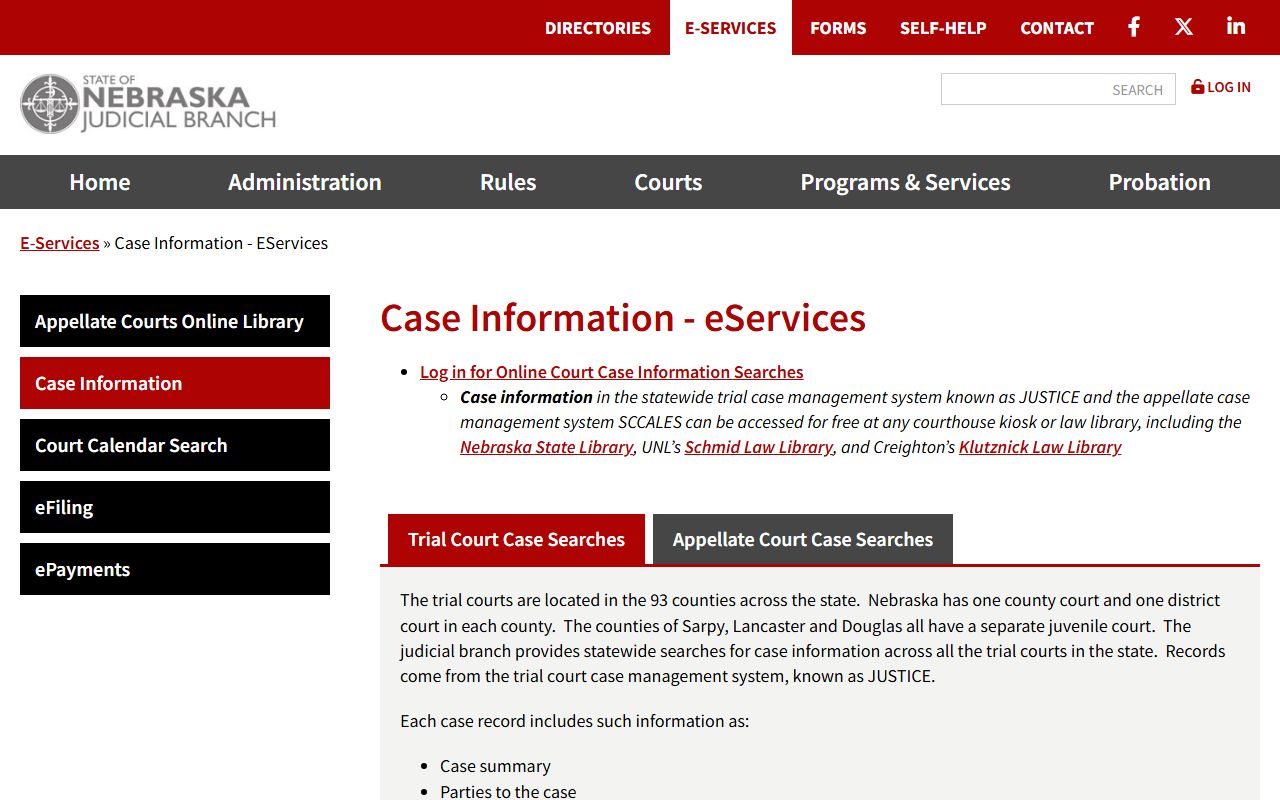
That statewide case system is the correct channel for filed charges after a Keya Paha County jail arrest, while the sheriff remains the local source for current custody.
- Search the JUSTICE one-time case search by defendant name, or use a courthouse public terminal when in-person access is practical.
- Use complete names and avoid over-narrowing at first, since the one-time search warns that too many limits can miss records.
- Open the matching case and review the charge list, case number, parties, court, hearing entries, bond orders, and register of actions.
- If the arrest is too recent to appear, contact the Keya Paha County Court or the district court clerk with the party name, case year, or case type.
Keya Paha Court Search Fees
The Nebraska Judicial Branch lists several access paths. Public courthouse terminals allow party-name or case-number searches without the same online one-time fee. The official one-time online name search costs $17, returns up to 30 records, charges even when no result is found, and keeps results available for three calendar days. A Nebraska.gov subscriber account is aimed at frequent searchers and has different subscription and case-detail charges.
| Search Channel | Cost or Limit | Best Use |
|---|---|---|
| Courthouse public terminal | Free terminal access | Party-name or case-number searches at the courthouse. |
| JUSTICE one-time name search | $17, up to 30 records, three calendar days access | Remote search when a courthouse visit is not practical. |
| Subscriber account | Annual subscriber charge and case-detail fees | Frequent court-record searching. |
| Judgment date or case number search | $2 each in Judicial Branch materials | Targeted case lookup when identifiers are known. |
Charges After Keya Paha Arrest
After booking, a prosecutor reviews the police or sheriff paperwork and decides what to file. The Keya Paha County Attorney is the local prosecutor, not a district attorney. A complaint often starts a criminal case. An information is a formal prosecutor-filed charging document used in many felony cases. An indictment is a grand-jury charging document and is less common than complaint or information in routine local cases.
| Complaint | Information | Indictment | |
|---|---|---|---|
| Filed By | Prosecutor, often using arrest paperwork | Prosecutor | Grand jury |
| Common Use | Initial criminal filing | Formal felony charging | Grand-jury charging process |
| Record Effect | Opens or supports the court case | Defines formal charges | Creates formal charges after grand jury action |
Booking charges and court charges do not always match. A booking entry may reflect what the arresting officer alleged at intake. The court record reflects what the prosecutor filed and what the judge later acted on.
Keya Paha Charge Status
Charge status is the part of court records after arrest that often matters most. A pending charge is still unresolved. An amended charge has been changed by later filing or order. A dismissed charge is no longer being pursued in that case. Nebraska records may also show events in the register of actions that explain hearings, continuances, warrants, bond changes, pleas, sentencing, or disposition.
| Status | What It Means |
|---|---|
| Pending | The charge remains open and has not reached final disposition. |
| Amended or reduced | The prosecutor or court changed the filed charge, level, or description. |
| Dismissed | The charge was dropped by order or prosecutor action in that case. |
| Convicted | The case ended in a guilty plea, verdict, or other conviction entry. |
| Warrant or hold entry | The court record may show a warrant, bench warrant, or custody-related order. |
Bond Orders After Arrest
Nebraska bond law starts with Neb. Rev. Stat. 29-901. A bailable defendant should be released on personal recognizance unless the judge finds that release will not reasonably assure appearance or could jeopardize evidence, victims, witnesses, or community safety. Courts may also set conditions of release. A PR bond means a written promise to appear. A detainer means another agency has asked that the person be held.
| Bond Type | How It Works |
|---|---|
| Personal recognizance | Release based on a written promise to appear and comply with court conditions. |
| Cash bond | Money is posted with the court or as directed by the court order. |
| 10% bond | Nebraska court form language recognizes a 10% cash deposit, with part retained as bond costs after appearance. |
| Corporate surety | A surety company backs the bond under court-approved terms. |
| No-bond hold | Release cannot occur by posting money alone, often because of another hold or court order. |
Keya Paha County does not publish local online bond payment hours, accepted payment methods, or an online bond vendor in the research. Call the sheriff or court clerk before traveling with money.
Warrants and Court Arrest Records
No official Keya Paha County active warrant search or most-wanted list was located. The sheriff page links to other law-enforcement resources but not to a local warrant database. A warrant can still lead to a jail booking and then court records after a jail arrest. An arrest warrant authorizes an arrest. A bench warrant is usually tied to a missed court event or court order. A search warrant authorizes a search, not a public custody lookup.
For warrant questions, call the sheriff at (402) 497-3201 or contact the relevant court clerk. The Keya Paha County Court page lists the county court at PO Box 349, Springview, Nebraska, with phone 402-497-3021. The district court clerk contact in county research is PO Box 349, Springview, phone (402) 497-3791. Do not try to clear a warrant based only on a website entry. Confirm surrender, bond, and hearing instructions with the court or counsel.
Charges vs Convictions
A charge is an accusation in a court case. A conviction is a final outcome after a plea, verdict, or other conviction entry. Court records after a Keya Paha County arrest may show both, but they should not be treated as the same fact. A dismissed charge may remain visible in a case history unless a statute or court order restricts access.
| Charge | Conviction | |
|---|---|---|
| Stage | Allegation filed by the prosecutor | Final guilt finding or plea outcome |
| Proof | Probable cause or filed accusation | Beyond a reasonable doubt or admitted by plea |
| Can change | May be amended, reduced, added, or dismissed | Changes only through later legal action |
Sealed vs Expunged Records
Nebraska has criminal-history redaction and set-aside rules, but the research did not locate a simple statewide rule that erases every arrest record after dismissal. Neb. Rev. Stat. 29-3523 governs criminal history record information and certain expungement or redaction situations, including arrests due to law-enforcement error. Neb. Rev. Stat. 29-2264 addresses set-aside of conviction.
| Sealed or Restricted | Expunged or Redacted | |
|---|---|---|
| Visibility | Public access is limited by law or order. | Specified criminal-history information may be removed or redacted where the statute applies. |
| Who May Still See It | Court or law-enforcement access may remain in some settings. | Depends on the statute and the record system involved. |
| Eligibility | Case-specific and not automatic for every arrest. | Limited to qualifying Nebraska law situations. |
Restricted Court Records
Some court records after arrest are not fully public. Juvenile matters, protected victim or witness information, active investigative material, confidential informant information, and records restricted by court order may be withheld or redacted. Nebraska public-record law is broad, but it does not override every confidentiality rule.
Important: Informal record searches are not FCRA consumer reports and should not be used for employment, tenant, credit, or insurance screening.